
Performance-Driven Safety in Acoustic Interiors
Fire-rated fabric acoustic panels used on interior walls and ceilings must reconcile two critical performance objectives: effective sound absorption and verified fire safety. In high-occupancy environments such as auditoriums, schools, offices, and healthcare facilities, interior finishes are regulated under strict fire classification systems. At the same time, reverberation control remains essential for speech clarity and acoustic comfort. Integrating fire resistance within textile-based acoustic systems therefore represents a multidisciplinary challenge combining material science, building regulation, and acoustic engineering.¹
Fire Testing and Regulatory Frameworks
Fire-rated acoustic panels are governed by internationally recognised testing standards that evaluate reaction to fire, flame spread, and smoke production.
European Reaction-to-Fire Classification
EN 13501-1 establishes a harmonised European classification system based on combustibility, smoke production, and flaming droplets². Materials are categorised from A1 (non-combustible) to F, with additional smoke and droplet indices (s1–s3, d0–d2). Interior wall and ceiling acoustic panels in commercial buildings typically require B-s1,d0 or equivalent ratings.
This classification ensures limited flame contribution and reduced smoke release, supporting safe evacuation and compartmentation strategies in public buildings.
ASTM E84 Surface Burning Test
In North America, ASTM E84 evaluates surface burning characteristics using a Steiner tunnel apparatus³. The test measures flame spread index (FSI) and smoke developed index (SDI), forming the basis for Class A, B, or C interior finish designations.
Fire-rated fabric acoustic panels targeting Class A compliance demonstrate low flame spread and controlled smoke development. Complete system testing—including fabric, core, and mounting assembly—ensures performance reflects real installation conditions.
Building Code Integration
The International Building Code (IBC) specifies minimum fire performance requirements for interior wall and ceiling finishes depending on occupancy classification⁴. Assembly spaces, corridors, and exit pathways often demand the highest classification levels.
Compliance documentation and third-party certification reports are therefore essential components of acoustic panel specification, particularly during permitting and code review processes.
Material Engineering and Acoustic Behaviour
Achieving fire resistance without undermining acoustic absorption requires careful material selection and assembly detailing.
Mineral wool and glass fibre cores provide inherent non-combustibility while maintaining high sound absorption across mid- and high-frequency ranges. Their porous structure converts sound energy into heat through viscous losses, reducing reverberation time and improving clarity. Research in room acoustics confirms the importance of fibre density and airflow resistivity in achieving stable absorption coefficients⁵.
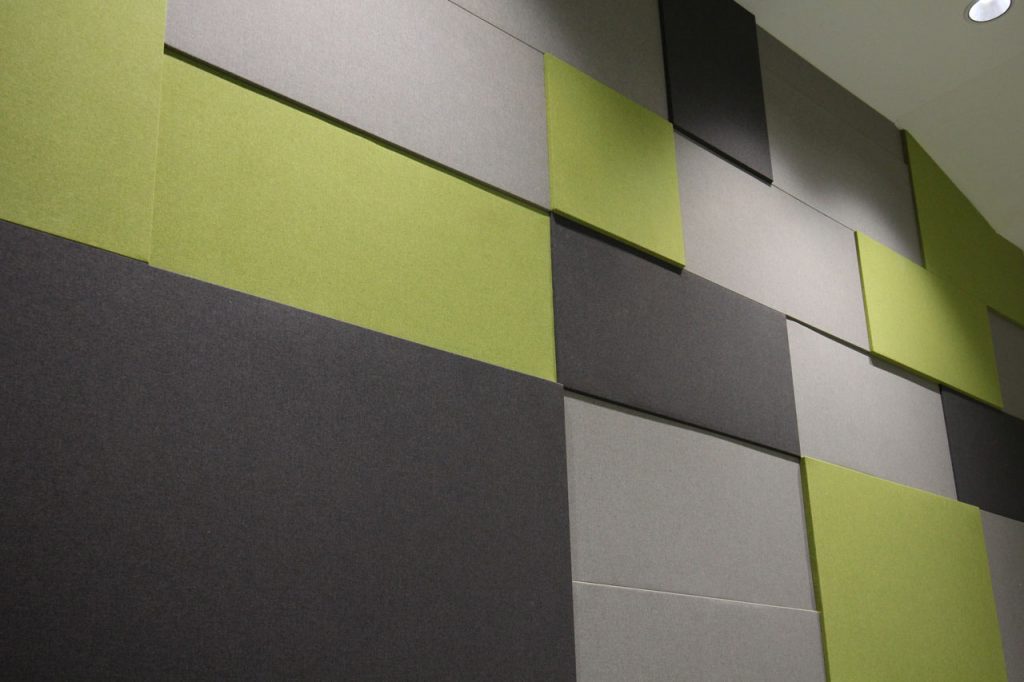
Textile facings must balance flame resistance with acoustic permeability. Inherently flame-retardant fibres such as Trevira CS integrate fire resistance within the polymer matrix rather than relying on surface-applied chemical treatments. This approach maintains durability and avoids degradation of performance over time.
Ceiling installations introduce additional considerations. Overhead panels must maintain structural stability during thermal exposure and integrate with non-combustible suspension systems. Tested assemblies ensure that acoustic enhancements do not compromise fire integrity above occupied spaces.
Design Strategies for Safe Interiors
Integrating fire-rated fabric acoustic panels within architectural design requires coordinated detailing and documentation.
Wall Assembly Compatibility
Panels mounted on fire-rated partitions must preserve compartmentation integrity. Detailing should prevent concealed cavities that allow flame spread while maintaining acoustic effectiveness.
Testing should confirm compatibility between acoustic systems and fire-resistance-rated wall substrates.
Ceiling System Coordination
Suspended ceiling panels must comply with both surface burning criteria and plenum fire safety requirements. Non-combustible grids and compliant fasteners reinforce assembly stability during fire exposure.
Proper spacing and anchoring reduce the risk of premature collapse.
Smoke Control Considerations
Smoke generation influences evacuation safety. ISO 5659 provides guidance on smoke density measurement during controlled combustion testing⁶. Selecting low-smoke materials enhances visibility and reduces inhalation hazards.
Fire-rated acoustic panels should demonstrate compliance with smoke-related indices alongside flame spread criteria.
Sustainable Fire Solutions
Fire performance can align with environmental objectives. Non-toxic, inherently flame-resistant textiles reduce reliance on halogenated additives. Sustainable material sourcing and transparency contribute to responsible interior fit-outs without compromising safety.
Integrating Life Safety and Acoustic Excellence
Fire-rated fabric acoustic panels represent a synthesis of safety science and acoustic engineering. By achieving compliance with EN 13501-1², ASTM E84³, and IBC requirements⁴, these systems ensure predictable behaviour during fire exposure. At the same time, porous absorptive cores and acoustically transparent fabrics maintain speech intelligibility and reverberation control essential to occupant wellbeing⁵.
The integration of inherent flame-resistant fibres, non-combustible mineral cores, and mechanically secure installation methods reinforces both regulatory compliance and long-term performance stability. Smoke density considerations⁶ further strengthen occupant protection during evacuation scenarios.
Modern interior architecture increasingly demands multifunctional systems that deliver acoustic clarity, fire safety, and sustainability simultaneously. Fire-rated textile acoustic panels meet these expectations by combining tested fire behaviour with measurable sound absorption. Through evidence-based specification and transparent documentation, designers can create interiors that are not only visually refined and acoustically controlled but fundamentally safe and resilient under regulatory scrutiny.
References
United Nations Environment Programme. (2022). 2022 Global Status Report for Buildings and Construction (2022). Global Alliance for Buildings and Construction.
European Committee for Standardization. (2018). EN 13501-1: Fire Classification of Construction Products and Building Elements. CEN.
ASTM International. (2021). ASTM E84: Standard Test Method for Surface Burning Characteristics of Building Materials. ASTM International.
International Code Council. (2021). International Building Code (IBC 2021 Edition). International Code Council.
Egan, M. D. (2007). Architectural Acoustics. McGraw-Hill Education.
International Organization for Standardization. (2019). ISO 5659-1: Plastics — Smoke Generation — Part 1: Guidance on Smoke Measurement. ISO.
Tags
Share