
Reverberation time (T60) remains one of the most influential acoustic parameters in architectural acoustics, performance venues, and speech-oriented environments. T60 represents the duration required for a sound field to decay by 60 dB after the source stops emitting sound.¹ Traditional prediction methods rely heavily on Sabine, Eyring, or ray-tracing calculations, but increasingly complex architectural geometries and material behaviours have encouraged researchers to investigate deep learning as an alternative predictive framework.²
Deep learning models are capable of identifying nonlinear acoustic relationships between geometry, absorption, diffusion, occupancy, and spectral behaviour. Instead of relying exclusively on simplified assumptions, neural networks learn from measured impulse responses, simulated datasets, and room-acoustic parameters to estimate reverberation performance with increasing precision.³ This transition has expanded the role of machine learning in architectural acoustics, especially within adaptive and data-driven design workflows.
Deep learning frameworks are reshaping how acoustic prediction models are developed for architectural applications and room-performance evaluation.
Traditional T60 equations assume diffuse sound fields and simplified room conditions. However, real spaces frequently contain irregular geometries, variable absorption distributions, and mixed reflective behaviour. Deep neural networks can process large acoustic datasets and identify hidden correlations that conventional equations cannot fully represent.⁴
Researchers commonly train convolutional neural networks (CNNs) and recurrent neural networks (RNNs) using room impulse responses, octave-band data, and material coefficients. Once trained, these systems can estimate reverberation times across different frequencies with comparatively low computational cost. This approach becomes particularly valuable during early-stage architectural modelling where rapid iterations are necessary.
Room impulse responses contain detailed information about reflections, decay rates, and spatial behaviour. Deep learning models analyse waveform characteristics directly, reducing dependence on manual parameter extraction. Spectrogram-based training methods further improve prediction accuracy by allowing neural networks to interpret temporal and frequency-domain features simultaneously.⁵
This methodology has improved acoustic prediction for auditoriums, classrooms, offices, and hybrid learning spaces. Neural systems are increasingly capable of estimating T20, T30, EDT, and full T60 decay curves from partial acoustic information, accelerating simulation workflows considerably.
Deep learning does not entirely replace traditional room-acoustic simulation. Instead, many researchers combine statistical acoustics, geometric acoustics, and machine learning into hybrid systems. Conventional simulation engines generate training data, while neural networks learn correction patterns and complex nonlinear behaviours.⁶
Hybrid workflows improve scalability for large projects while preserving physical interpretability. In practice, this allows architects and acoustic consultants to estimate reverberation performance rapidly during conceptual design stages before detailed acoustic modelling begins.

Deep learning systems are increasingly capable of predicting reverberation behaviour across multiple octave bands rather than relying on single broadband averages.
Low-frequency reverberation remains especially difficult to model because modal behaviour introduces irregular decay characteristics. Neural networks trained on extensive room datasets can identify recurring spectral relationships associated with material density, room volume, and boundary conditions. This enables more stable low-frequency predictions compared to simplified statistical equations.
Mid-frequency behaviour often aligns more closely with classical acoustic theory, yet deep learning improves the interpretation of mixed-material environments. Open ceilings, suspended absorbers, and partial-height acoustic treatments create complex reflection patterns that benefit from nonlinear predictive analysis. Neural systems can interpret these interactions more effectively when trained on measured acoustic datasets.
High-frequency T60 estimation also benefits from machine learning integration. Surface texture, scattering, seating occupancy, and perforated absorbers significantly affect decay behaviour above 2 kHz. Deep learning models can recognise these combined influences without requiring extensive manual parameterisation, improving prediction consistency for speech-oriented spaces and critical listening environments.⁷
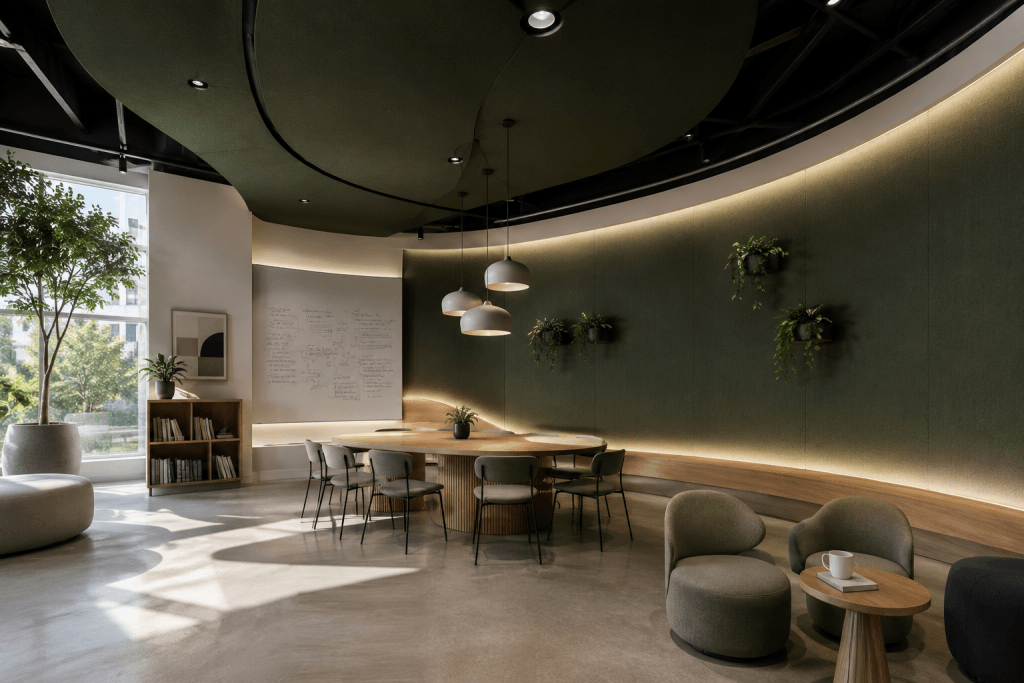
Modern acoustic prediction increasingly intersects with digital architecture, BIM systems, and computational design workflows.
Deep learning models can connect directly with Building Information Modelling (BIM) platforms. Material schedules, room geometries, and surface properties become usable acoustic inputs without requiring complete manual acoustic reconstruction.
This integration shortens coordination time between architects and acoustic consultants while enabling earlier reverberation assessment during schematic design stages.
Some research platforms now provide near real-time T60 estimation using trained neural networks. Designers can adjust ceiling systems, absorptive finishes, or room proportions while receiving immediate acoustic feedback.
This capability supports iterative architectural workflows and encourages acoustically informed decision-making before construction documentation begins.
Transfer learning allows pretrained acoustic models to adapt to new room types using smaller datasets. Instead of building entirely new prediction systems, researchers refine existing neural frameworks for classrooms, theatres, healthcare facilities, or open-plan offices.
This reduces computational training demands while improving flexibility across multiple architectural sectors.
Deep learning models increasingly recognise complex material interactions that are difficult to represent through static coefficients alone. Fabric tension, perforation geometry, porous absorbers, and hybrid acoustic systems may demonstrate frequency-dependent behaviour that varies under changing environmental conditions.
Machine learning frameworks can identify these nonlinear trends through measured acoustic datasets, improving predictive consistency across diverse architectural materials.

Deep learning continues to transform reverberation analysis from a static engineering exercise into a dynamic predictive ecosystem. Neural networks now support faster simulation, adaptive modelling, and frequency-sensitive reverberation estimation across increasingly complex architectural conditions. While classical acoustic theory remains essential, machine learning introduces new possibilities for interpreting spatial acoustics beyond simplified diffuse-field assumptions.
Future developments will likely combine deep learning with sensor networks, digital twins, and real-time environmental monitoring systems. Adaptive buildings may eventually adjust acoustic treatments automatically based on occupancy, speech intelligibility requirements, or environmental noise conditions. As computational acoustics evolves further, T60 prediction will increasingly operate as part of a responsive architectural intelligence framework rather than an isolated post-design calculation process.
References
Long, M. (2014). Architectural Acoustics. Academic Press.
Kuttruff, H. (2016). Room Acoustics. CRC Press.
Ntalampiras, S., & Potamitis, I. (2012). Detection of Human Activities in Natural Environments Based on Their Acoustic Emissions. Sensors, 12(9), 12344–12358.
Yu, C., & Kleijn, W. B. (2021). Room Acoustical Parameter Estimation From Room Impulse Responses Using Deep Neural Networks. arXiv, 2021.
Mirsamadi, S., Barszczyk, B., & Zhang, C. (2014). Automatic Speech Emotion Recognition Using Recurrent Neural Networks with Local Attention. IEEE ICASSP Proceedings, 2014.
Vorländer, M. (2020). Auralization Fundamentals of Acoustics, Modelling, Simulation, Algorithms and Acoustic Virtual Reality. Springer.
Habets, E. A. P. (2006). Room Impulse Response Generator. Technische Universiteit Eindhoven.
Published
Tags
Share